Formed 2004 ... Herts 7s U14 Runners-up 2005 ... North Herts U14 team, Herts Youth Games 2005 runners-up (coached by Letchworth)... Herts Superteams U14 Runners-up 2005 ... Herts SuperTeams "Fairplay" winners 2006 ... Rochford 10s U17 Champions 2006 ... East Midlands 10s U17 Runners-up 2007 ... East Midlands 10s U17 "Fairplay" winners 2007 ... National 10s U17 5th place and "Fairplay" winners 2007 ... Herts 7s U17 Plate runners-up 2007 ... National 7s U17 Plate winners 2007 ... RFU "President's XV" Award winners 2007 ... Herts Superteams winners 2007 ... Midlands 10s U18 Runners-up 2008 ... National 10s U18 4th place 2008 ... North Herts U11 team, Herts Youth Games 2008 runners-up (coached by Letchworth girls) ... London and SE 7s U18 Plate runners-up 2008 ... Herts 7s U18s runners-up 2008 ... National 7s U18s quarter-finalists 2008 ... Gloucester City 10s U18 Bowl runner-up (6th) 2009 ... Worthing 10s U18 Plate runner-up 2009 ... National 7s U18 Plate winners 2009... Worthing 10s U15 Plate winners 2010... Worthing 10s U18 Shield winners 2010... Herts 7s U15 and U18 Bowl runners-up 2010... National 7s U18 Plate runners-up 2010...

Sunday, July 17, 2011

Who needs a sevens programme?

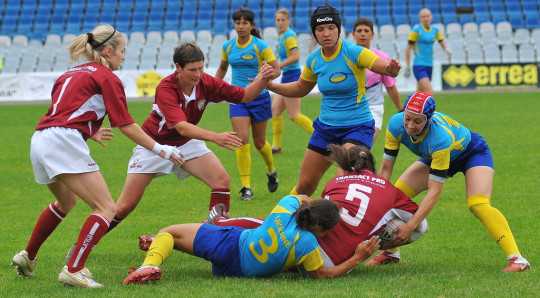
It's England... European Sevens Champions! And all this despite something terrible happening to their shirts in the wash (well, that or their tactic was to pretend to be Dutch...)
So - who needs a specialist sevens programme? That might be the conclusion from England's win today at the European Sevens Championship in Bucharest. After a fascinating (and rather warm) tournament, England lifted the title for the fourth time, beating globe-trotting 7s specialists Netherlands and Spain on the way - the latter twice, including a dramatic 17-7 win in the final (which may be shown in Eurosport 2 at around 9pm this evening).

England's new-look sevens team were at their first international tournament after preparations which included three domestic club sevens (resulting in three finals, and one win) since June, and the big question was how this preparation would compare with teams that have played nothing but sevens for the better part of a year.

The answer was pretty well. Admittedly the draw helped, with an opening game against one of the weakest teams in the tournament (Romania), who were swept aside 46-0, before a game against the only international side England were familiar with - Sweden - who were beaten 20-5.

Netherlands v France. At least one team knows what
shirts they should wear...
Now well into their stride, England went into what amounted to a quarter-final with Italy, and ran out comfortable winners again, this time 20-7. With a semi-final place effectively assured, the pressure was off for the games against Spain (15-5 win) and Germany (33-7).

RFU report on Day 1

If England's Pool A had gone more or less to plan, the same could not be said for Pool B. France were shattered by an opening defeat to Portugal, not recovering until their fourth game - by when they were out of contention. Netherlands were sweeping all before them - until they lost their key player, Kelly van Harskamp - sent off after two yellows against Portugal. With their best player unavailable they lost their next game to Russia, meaning that they would meet England in the semi-finals.

This proved to be an incredibly tight game. With van Harskamp back after her one game suspension the Dutch were very dangerous - but in the end it was they who cracked. Two crucial errors either side of halftime were enough to give England a 14-0 win, and a place in the final... against Spain.

Amazingly, every European Sevens has ended with either Spain or England in the final - and, for the third time in seven events, they met each other. England had won every previous game the two teams had played, and after four minutes a Spanish error gave England the lead. But it did not last - and Spain came back, going in to half-time 7-5 ahead.

To confuse the world at large, this score then appeared on the tournament website as the final score, prompting celebrations at the Spanish RFU in Madrid. However, it was not to be for Spain. England roared back in the second period with two tries and a dramatic 17-7 win.

RFU Report on Day 2

So - do you need a Sevens programme? Well, truth be told it was a "damn close run thing" (to misquote Wellington) and, in the end, it is probably England's professionalism and familiarity to pressure that will have seen them through. What is clear, however, is that the rest of Europe are gaining. The "OMG its England!" factor still plays to England's advantage, but the Dutch at least are less fazed than they used to be (going from 52-0 in 2008 to 14-0 now), and Spain were within minutes of winning as well. With the Dutch - as a result of their 3rd place - getting full-time professional funding from their Olympic Committee, the gap is going to close even more. And that is before you take into account what is happening in Sevens outside Europe.

Fortunately, of course, England do now have a Sevens programme - in essence it starts here. We are promised a dedicated squad who will tour the world, alongside the Dutch, Spanish, French and Canadians - amongst others. Next year could see this European Championship expanded to a three tournament event, as well as a World Cup qualification process. 2013 will be World Cup year, then it'll be straight into Olympic qualification. Its going to be an exciting ride.

Friday, July 15, 2011

Women's international rugby's big weekend

This is one of the year's biggest weekends of international rugby with international championships and tournaments being competed for in four countries on three continents.

The NACRA Caribbean Championship reaches its climax tonight (or early tomorrow morning our time) with host nation the Cayman Islands taking on Trinidad & Tobago for the title. Cayman Rugby TV will have all the action, and an ever so slightly biased summariser from around about 2am BST, though recordings of all games are available for viewing at a more civilised hour. In practice T&T (as they are universally referred to) should stroll it as they seem to be a mile ahead of anything else in the region, with player-of-the-tournament Juliana Straker very likely to add to the 41 points she has personally racked up in just two games to date - but what this tournament has shown is how much the teams desperately need competition from outside their region.

Tomorrow in Kampala the second leg of East Africa's Elgon Cup takes place, with Uganda attempting to overturn a 12 point defeat to Kenya from the first leg in Nairobi. Like the NACRA tournament, this is a fiercely contested annual competition involving teams that live an isolated test match life, playing no-one but themselves. If the game is to grow they must be given a chance to play outside their region - and the World Cup should (in theory) allow them to do that. In the meanwhile, though Uganda may shave a win its probable that Kenya will retain the overall title.

At around the same time in Bucharest the FIRA European Sevens Championship kicks off. This one is the "top division" with the leading 12 nations competing for the title. In practice it will be a battle between five teams - Netherlands, France, Spain, Italy and England - with the last three in the "group of death" that will see one of them knocked out before the semi-finals.

It should be fascinating stuff with England's mainly 15-a-side superstars up against sevens specialists, most notably the Netherlands. Can players from the long game easily convert to the wild and hectic world of Sevens, or is the short game now almost a separate sport in its own right? We should have a clue by Sunday. England have selected a much stronger team this year than the one that finished 5th last year in Moscow, and will be expecting to make the last four as a minimum, but the Italians, Dutch, Spanish and French are pretty much at full strength.

The big game in the opening pools will be England against Italy on Saturday afternoon - win that and England will be in the last four after which... well, anything could happen. I fancy Netherlands to just take the title, but with Spain and England not far behind.

The tournament will be shown live on Eurosport 2 in many parts of Europe.... except in the UK.

Then late Sunday, early Monday we have round two of the U20 Nations Cup with England and the USA - the two winners from round one - face-to-face. England will win, of course - they brushed past Canada in round 1 and most observers would see the Canadians as a step or two ahead of the Americans. South Africa will, meanwhile, be aiming to recover from a disappointing opener where - like their senior side at the world cup - they suffered badly from poor discipline, throwing away a great start to lose comfortably.

The ongoing internet problem at Storke Field will probably mean no live feed for this round, but again a recording of the game should be available for breakfast viewing on Monday morning.

Follow the Nations Cup from inside the USA camp

The USA team have again set up a blog giving an insight into what it is like to be part of an international team, from the preparations to the tournament itself.

USA Rugby U20 WNT blog

Nations Cup, round 1: England v Canada (and an apology)

First, apologies to everyone who tuned in at midnight last night - it seems that there was no internet feed available at the ground, so YSC had to record the game and then rush it over to somewhere where there was one. Bit of a blow to faith in US technology! On the plus side a recording of the whole match is available, below. For some reason there is no sound, except for the first second or so when you can hear someone say "I'm going to turn it off"...

A complete text blow-by-blow account this game and USA v South Africa is also available on YSC - and I guess, unless or until the lack of web access issue is solved, that is going to be the best way to keep in touch with the next round of games. The third round and final are to be played elsewhere, so hopefully we will get a live feed from them.

In the meanwhile if you do not know the result watch below, or page down to the end of this post...


.
.
.
.
.
.
.
.
.
Results from Day 1: England 41, Canada 0; USA 25 South Africa 3
RFU Match report:
England Women U20s 41 Canada Women U20s 0
England Women Under 20s inflicted an impressive 41-0 defeat on Canada in the opening round of the Nations Cup in Santa Barbara on Thursday night. 
The England young guns ran in a massive seven tries against their North American rivals and Canada had very little response. 
Bristol’s Rebecca Hughes and Saracens’ Hannah Gallagher ran in braces of tries whilst there were also touch downs for Natasha Jones, Katie Mason and Ceri Large. Bristol centre Amber Reed added three conversions 
England Under 20s Head Coach Amanda Bennett said: “The aim for this opening match was not just to win but to make a statement of intent. We wanted to demonstrate that we have built on the success of our spring games and improved in many areas, not least our defence. 
“Canada dominated parts of the game especially at the scrum, and we were often forced on to the back foot. However, our organisation and execution in defence proved to be a crucial element in the victory as our tackle completion and turnovers meant Canada rarely got close to scoring. We made the most of the turnovers, some of which were eventually converted into tries. Our midfield and back row worked extremely well together to turn possession over.” 
England started at a furious pace, registering their mark on the scoreboard after just five minutes. A good drive through the centre from Old Albanians hooker Geri Thomas saw the ball taken on by fly half Jones. Despite taking a crunching tackle she retained possession and crashed over under the posts. Reed added the conversion. 
England maintained their pressure and were rewarded on nine minutes with a second try, which saw good hands throughout the backline setting up Bristol winger Mason for a try in the corner. Reed this time couldn’t make the conversion but it did not matter as England soon extended their lead to 17-0 on 20 minutes. 
The score was the first of Hughes’ two tries, but there was also some excellent support play from Alexandra Matthews, Reed and Jones. Jones also made an excellent line break followed by some good interplay between Jones and Hughes, which gave Hughes the space to score.
Again Reed missed the conversion but England took a healthy 22-0 lead into the break with Gallagher touching down for England’s fourth try. 
Canada held England back in the opening stages of the second half, keeping England pinned in their half for some time. The Red Roses, however, broke the deadlock on 53 minutes with Gallagher again at the heart of the action. 
An excellent drive by Mason down the right wing saw the winger come close. Gallagher was in support and picked up to muscle her way over the line from three metres out. 
Canada had their chance to put some points on the board with two consecutive penalty attempts but they weren’t successful and England moved ahead with a late run of tries in the dying minutes of the game. 
On 78 minutes, England overturned Canada after a period of sustained pressure from them. Prop Emily Kingston moved the ball out to Hughes, who sprinted 60 yards to outflank the Canadian defence to score in the corner. Reed added the conversion to make the score 34-0.
Worcester centre Ceri Large added the final try after a good break by Emily Scott saw her come close to scoring. Large was in support and a good Scott offload saw her finish off the move with a simple run under the posts. Reed’s third conversion handed England the 41-0 victory. 
England U20s next play hosts, the USA, on Sunday and Bennett added: “On Sunday we will face a very confident USA team that is relishing playing on home soil. We have plenty to work on in the next two days but the positives from this opening game are many and we are looking forward to the challenge.”

Thursday, July 14, 2011

Watch the U20 Nations Cup here LIVE: Tonight

The U20 Nations Cup - including England, USA, Canada and South Africa - kicks off next week, and you can watch all the games here - live - thanks to a live webcast being organised by USA Rugby and YSC.

The England party includes four Hertfordshire girls - two of whom are in the starting line up for England's opening game against Canada, which kicks off at midnight UK time.

***Sorry - for some reason the video is delayed by four hours... no idea why...***


England's other games will be:
USA v England (July 17)
England v South Africa (July 20)
Consolation Finals/Finals (July 23)

Wednesday, July 13, 2011

Anticipating a big win?

RFU to provide mathematical support
for spectators of the Nations Cup?
The U20 Nations Cup kicks off tomorrow, and - going by the RFU website - England are quite supremely confident.

Admittedly they have every right to be - after all, they have won every game they have played in the tournament, and - against North American opposition - average over 50 points per game.

However, it seems that England are so confident about a big win in their opening game that they suspect that spectators will have problems keeping up with the score, and as a result professional assistance will be provided.

Or, as they put it in the match preview on the RFU website...

Okay, I am maybe the last person who should be making fun of someone else's typo... Sorry, Julia :)

Tuesday, July 12, 2011

Women's rugby's ultimate all-rounder?

Meet Emmi Laine, who will be playing for Finland in the European Sevens this weekend. What is so special about her? Well, she is one of the more remarkable, not to say busiest, people in the rugby world.

Emmi, 28, who comes from Jyväskylä in Finland is, presumably in her "spare time" (being as its pretty unlikely that anyone in Finnish rugby gets paid) ...
  • Finland's first ever female international rugby referee (refereed at the European Sevens Division 2 tournament two weeks ago)
  • Centre/wing for Finland's 15-a-side national team
  • A leading member of Finland's sevens team ("player of the tournament" at the Amsterdam Sevens in 2010)
  • A leading administrator with Finland's national rugby union
  • The IRB's "lead contact" for women's rugby in Finland
  • Organiser of Finland's famous "Lumirugbya" (snow rugby) tournament
In short, there is almost nothing in Finnish rugby that she does not seem to do, other than maybe drive the coach. Is there any one person anywhere else in the world more involved with in every aspect of the game than Emmi?

Sunday, July 10, 2011

Exercises for girls' rugby

Just come across these short videos of various individual exercises, aimed at girl rugby players, but really relevant to any young players - or come to that anyone else. They have been put together by Carl Walsh, coach of West Park U15s in Leeds.

They are pretty good. Some of the positives...
  • The drills are simple, low intensity exercises relying on repetition
  • No weights are used (as such things are, with good reason, frowned upon for young players)
  • They are all individual exercises, so can be used for all sizes of training group
  • Nonetheless many would make good warm-up exercises before a team session
  • The instructions are clear, with good information about the purpose of each drill
As well as being of value to players, these videos would be really useful for anyone doing GCSE PE or similar, not least as an example of how to make simple, clear and effective exercise videos!

The first video is below - the other seven can be found here

Saturday, July 09, 2011

Another ex-Legend flies the flag

Chloe (left) and her team-mates
News from northern France where ex-Legend Chloe Baker has been playing for Leeds Met in the European Universities Rugby Sevens championship.

Its a bit grand a title for what is, in essence, an invitational sevens for universities mainly from England, France and Germany (plus one from Portugal) - but what is very clear from the limited news and results from weekend is that a) its huge fun and anyone who gets a chance to go in the future should not miss out, and b) English teams are well off the pace when it comes to Sevens!

It's a tough game when your opponent is 7'3!
As Chloe reports "My team did really badly but it was a great tournament. The French, German and Portuguese sides were all really strong and the tournament was really well organised."

Chloe's team were not alone in "doing badly". Ten universities took part - four from England, three from France, two from Germany, and one from Portugal. And it was the Sevens specialists from Portugal - the University of Coimbra - who took the title, while France's three entries finished 2nd, 3rd and 4th. The English and German entries disputed the minor places, with Chloe's Leeds Met team - national champions (at 15s anyway) - finishing 8th.

Randy takes on England

A nice picture here of ex-Legend Rosie Randfield taking on yet another international opponent in her career with the British Army team - in this case England at the Newquay Sevens.

Unfortunately the game did not go well for Rosie's team, who lost 44-0 - and England went on to win the tournament, in their last warm-up before they travel to Moscow for the European Championships later this month.

More LIVE women's international rugby

Next week's Nations Cup will not be the only women's international rugby available via live webcast this week - the Caribbean XVs Championship in Grand Cayman will also be broadcast live, starting tomorrow evening (our time).

The Caribbean championship is one of the longest running, but also isolated, tournaments. First played in 2003 it has been played more or less annually since 2006. The whole tournament takes place over a single week - much like the European XVs championship.

Unfortunately the many of the region's RFUs find the cost of getting their teams to the tournament too expensive, and rarely has there been an event where every island took part. As a result a Caribbean Select team has now been formed so that the leading players from any islands unable to field full teams can still play.

Previous winners:
2003: (in Trinidad) - Trinidad & Tobago
2006: (in Jamaica) - Jamaica
2007: (in Cayman Is) - Cancelled due to a hurricane
2008: (in Guyana) - Trinidad & Tobago
2009: (in Barbados) - Trinidad & Tobago
2010: (in Bahamas) - Cayman Islands

None of the teams taking part have ever played any outside the Caribbean so it is difficult to know how they compare with the rest of the world. However, this year the tournament takes place in the Cayman Islands - probably the wealthiest member union in the region - and it is promised that all of the games will be available via Cayman Rugby TV - so we can at least watch the games and make our own judgements. Unfortunately, the kick-off times are not that user-friendly.

2011 match schedule:
Sunday 10th July:
10pm (UK time) - Trinidad vs Caribbean Select
Midnight - Cayman Is vs Jamaica

Wdnesday 13th July:
2am: Jamaica vs Trinidad
4am: Cayman Is vs Caribbean Select

Friday 15th July:
2am: Jamaica vs Caribbean Select

Saturday 16th July:
2am: Cayman Is vs Trinidad

(This does beg the question - again - about why, if rugby unions in the USA and Canada and Latvia and the Caribbean and so on can all manage to webcast their games, why unions in the UK and Ireland are still in the technological dark ages...)

Monday, July 04, 2011

A new force in women's rugby?

Ukraine (blue) in action against Latvia last weekend
Watch out leading rugby nations of Europe, the Ukraine are coming...
  • Before 2009 they were the largest European nation that had never fielded a women's rugby team
  • In 2009 the entered the European sevens for the first time. After a heavy defeat in their first game, they recovered to win finish third.
  • In 2010, lessons learned, they stormed the Division 3 championship, scoring 182 points in seven games while conceding only one try, demolishing pre-tournament favourites Hungary in the final.
  • What its like to play the Ukraine...
  • Last weekend, in Division 2, they did it again. Only more so. This time - against theoretically tougher opposition - they blasted their way to 300 point in sevens games, again letting in but one try. The closest game was a 31-0 thrashing of Belgium, while their semi-final and final saw then rack up 88 points against the Czech Republic and Switzerland - two pretty decent teams.
And in 2012? With Ukrainian feet under the top table - and World Cup qualification to be decided - there will be a few nations looking a bit nervous. Teams like Netherlands, France and Spain probably have little to worry about, but for other countries likely to be scrambling for the last couple of European places at Moscow 2013 it looks like a pretty serious rival has appeared, almost from no-where. Russia will be definitely pleased that the hosts will not have to qualify!

Beyond that... obviously this explosion has a lot to do with the Olympics, though there must have been something there before 2009 for the Ukrainian RFU to build on. The big question - and the big test of the IRB's policy in promoting sevens to expand the game - will be whether or not the Ukraine can or even want to transfer their sevens skills into the more serious and testing XVs game. Here's hoping they will!

Barette - solving the mystery of French rugby?

More on the French game of Barette has now come to light.

As mentioned yesterday, this was a game that was very similar to rugby and was widely played by women in France in the 1920s.

Digging round a bit more I have discovered that the game was rather older than the 1880s, as described yesterday. That seems to be the date when the game was codified, with one set of rules based on the way the game was played in Paris. However the game was far older than that, and was mainly played - to a range of varying rules - in the south west of France, or in other words the very areas of that country where rugby is the principle game today.

Barette was - in effect - "French football", a game developed from a variety of local football-type games, much in the same way that rugby and soccer developed in England - and for much the same reasons (ie, so it could be played in schools, and so that schools could play each other).

The game they came up (and there are more details here) with was spookily similar to rugby, so that the sports looked practically identical. However the differences were there - and significant. To tackle the ball carrier you had to touch not the player (as it had seemed in the films) but the ball itself. If you managed that and called "hit" or "touch", a scrum was formed. However, originally this was a circle of players who gathered round the ball after it was dropped on the ground and kicked it until it emerged from the circle (clearly by the 1920s a rugby style scrum had replaced this near chaos).

In fact, the more you look at it the more it seems be the answer to one intriguing question. After all, why did rugby gain such a hold in France? It is the only country outside the Empire to ever fully embrace the game (though admittedly the USA came close). And the answer seems to be barette - a local game that was so similar to rugby that it must have been very easy (and tempting) switch from a "quaint" local "schoolchildren's" game to a sport that not only offered the prospect if international competition but - at the time - seemed likely to be the world's leading football code. And with barette so popular in the south west it is also no surprise to see that rugby also became hugely popular in that region.

This also probably explains barette's eventual disappearance - because the leading suspect in the death of barette must be rugby itself. By the 1920s only women seem to be playing it, and then all it needed was a change in attitudes to women playing sport  - as happened at the same time in England (where women's soccer was banned) and in Australia (where women's rugby league suffered the same fate) - and the sport died. Today no-one appears to play barette anywhere.

Which just leaves one question - what did the women (such as those above) think they were playing? If asked if they were playing rugby would they have said "yes - it is the women's form of the rugby" (much as camogie is the women's form of hurling, or netball was for many years the women's version of basketball), or would they have insisted that - despite appearances - it was a totally different sport? I suspect the former, but as its now nearly 80 years since barette was played we will probably never know.

Saturday, July 02, 2011

Barette - women's rugby 100 years ago

Frederic Humbert (of the Rugby Pioneers website) has uncovered a new picture of a very early women's rugby team, in this case from 1925. In practice it looks like this is a "barette" team - a form of rugby that was popular in France in the 1920s (you may remember a film from 1928 appeared here back in 2008).

Hunting around a bit, I've now unearthed the rules of this game - worth a look, especially with the proposed U13 rule changes that the RFUW are seeking to impose. Another French rugby website - http://www.ballon-rugby.com - gives the following information:

At the end of the nineteenth century rugby is far more widely played in France than football, but even so children at many schools in Paris and the provinces did not play the game, but instead played a simplified game which was very similar: Barrette.

The "barette" was an was ovoid ball (like a rugby ball), consisting of a rubber bladder wrapped in leather and measuring about 30cm long and 20 wide. The sport was played on a field, or some other place big enough to allow the free movement of twenty to thirty players divided into two teams. It was possible to kick the barrette, or pick it up and carry it towards the opposing goal.

There were two methods of scoring - either a kick (sending the ball between two posts) or placing it between the posts. If a player failed to do either but instead placed behind the goal line outside the posts, they won an "advantage" and were entitled to a free kick at goal (these scoring rules are all but identical to early rugby rules).

What was special about this sport (compared to rugby, as played at the time) was that any contact or violent aggressive action is prohibited. An opponent could get in his way of the ball carrier, but not struggle with them. They just needed to touch the player carrying the barrette and shout "hit!" Play would then stop, and a  scrum would be formed. In summary, when created (in the 1880s) it was like rugby, but with less violence.

From its introduction it spread quickly. The first inter-school championship began in 1890 with three teams, eight the following year and 15 by 1892. The clubs appeared in the provinces with a growing membership. School children played almost every day, alongside their studies, work and family life, and the quality of play improved.

By the 1920s the game seems to have become an exclusively women's sport, with rules about contact relaxed (if the film clips are any evidence). National championships took place, but the sport never seems to have been played outside of France - and in the 1930s - 50 years after being introduced in schools - it seems to disappear.

What is fascinating is how much this reminds me of the U13 rule debate. The motivation - the creation of a simplified, less aggressive form of the game primarily for use in schools - is identical. The form of play - sort of glorified touch or tag - sounds very like what is being proposed today.

The interesting question is whether it worked, and the answer seems to be a qualified yes - there were more players playing a rugby-type game than there would otherwise have been BUT there is no evidence that Barette players moved in any measurable numbers into "proper" rugby. No true women's rugby develops (unlike in Australia and New Zealand 10 years later). Instead all that happens is that clubs are formed to enable players to carry on playing the simplified game into adulthood. The question is whether history will repeat itself 100 years later, and whether RFUW will consider the creation of lots of adult tag players to be a success.

Friday, July 01, 2011

Euro Sevens: Eyes on Riga

After the excitement and razzmatazz of yesterday's big announcement for the XVs game, its back to Sevens this weekend and the Second Division of the European Championship.

The goal for the 12 teams playing in the Latvian capital this weekend is promotion to the top division of European Sevens, and maybe through that qualification for the 2013 World Cup.

And it could not be more wide open. Really. 10 of the 12 teams taking part can all harbour realistic hopes of winning the prize - only Malta and Israel will be starting with worries about likely relegation in their minds.


Switzerland in particular will have a point to prove. Beaten finalists in 2010 they were overlooked for promotion to the top table following Wales's withdrawal in favour of Romania (because they are hosting the First Division) - a decision that provoked the response "WTF?! We *thrashed* them last year!" from one of the Swiss players (other responses are less printable).

However, they will not have it their own way by a long chalk. Ukraine and Norway, both up from Division 3, look good - Ukraine in particular, who have blown most opponents away since they appeared on the women's rugby scene only three years ago. Throw in teams like the Czech Republic - arguably central Europe's leading team - as well as Andorra  and Belgium (who have both appeared in the top division in the past, and are desperate to return there) and it promises to be a fascinating weekend.

Even better, a live video feed is promised. Fingers crossed on that one...

World Cup promo: you have GOT to watch this

If there is a best prize for the best ever women's rugby promotional video then this wins. Hands down. Especially if you went to the Women's Rugby World Cup last year (or even watched it on TV).

So stop what you are doing, sit down, pump the speakers up to 11, and watch this...


And meanwhile, more reaction to yesterday's announcement...

Thursday, June 30, 2011

WRWC France 2014: the announcement

Translated from a report by Jacques Corte, DfO
Representatives from England (Katy McLean), New Zealand (Stephanie Teohaere-Fox), IRB (Susan Carty), France (Marie Alice Yahé) and Ireland (Fiona Coglan) at today's announcement in Paris. (Thanks to DfO for the picture)
"At Versailles, today (Thursday, June 30), during the Congress of the FFR, the IRB Chairman, Bernard Lapasset, and the President of the French Rugby Federation, Pierre Camou, announced that the the 7th Women's World Cup Rugby 2014 would be held in France, in Paris. The announcement was enhanced by the presence of four major players from four nations, as well as Susan Carty, in charge of developing the women's game at the International Rugby Board.

Salon Pascal on the first floor of the Palais des Congrès de Versailles in Thursday, June 30, 2011. The people who matter in international rugby are all there. Great men's rugby players from the past such as Serge Blanco, Jean-Pierre Lux, and Jean-Claude Baqué were there as a reminder of France's contribution to the men's World Cup over the past 20 years.

But this time it is women's rugby taking centre stage. After the success of the World Cup in England (partial or total TV coverage in 127 countries; popular success thanks to the enthusiasm support of English fans, and a high level of attractive play) IRB drives home the point - and wants to capitalise:

"The women's rugby is booming," argues Bernard Lapasset. This is also highlighted by Susan Carty, newly responsible for the development of women's participation in the world rugby: "There are nearly 200,000 registered players around the world and women's rugby is played in over 100 countries,"she says.

Bernard Lapasset highlights need to motivate emerging rugby countries. " China," he said, "decided to make a rugby a priority sport. But we also note that Brazil is becoming a major nation. Of course the popularity Sevens within the Olympics is important and women's rugby is getting better and better. In Iran, where the game advances, particularly in the universities shows it again." He concludes: "With the holding of the World Cup in France a major new step in this development that opens."

Next, Pierre Camou gives some tips: "We will organize the 2014 edition and thus contribute to breaking the "machismo" that exists in the game. This event should help to break the existing stereotypes and confirm the progress of women's rugby. We just passed its 10,000 registered players in France and the financial investment made ​​by the FFR is growing. Nearly 3 million Euros on a federal budget of 80 million. It is also important to revitalize the sporting challenge and try to end the dominence of the two leading nations: England and New Zealand. "

Marie-Alice Yahe, captain of France, highlights "the double pride in wearing the colours of the national team and to play the major competition in your own country." Katy McLean, England captain, talks about the excitement experienced during the World Cup: "Playing a World Cup at home, it's huge"she concludes.

Also present Stephanie Teohaere-Fox, Black Ferns hooker, who is very complementary about the French, saying: "It's always a pleasure to play France. This will be even more in your country. I look forward, as the last World Cup final in England had a big media impact at home." Fiona Coghlan, arriving just in a rush because of a delayed plane, added that the momentum of good World Cup for Ireland was an important and her sporting goal would now be "reaching the semis in France. "

After Bernard Lapasset did report a UK study estimating that the impact of the 2010 World Cup  was worth over 2 million Euros, after which Pierre Camou had the last word announcing a few specific points:
  • a budget of about of 500,000 euros (equivalent to the 2010 in England), 
  • the use of the National Rugby Centre to facilitate and reduce the costs of hosting the qualifiers, and take advantage of training conditions on the site of French rugby. 

World Cup stays in Europe

In what might be seen as a surprise, the IRB today announced today that the next World Cup will be in France.

After Wales (1991), Scotland (1994), Netherlands (1998), Spain (2002) and England (2010) most people expected that the tournament would have to go somewhere other than Europe. As a result, when in 2009 bids were invited to host the 2014 event, no European RFU came forward.

However, last year's World Cup in Guildford and London changed everything. First, the huge success of the event raised questions about whether awarding the tournament to small nations such as Kazakhstan or Samoa would be a backward step. But - perhaps more importantly - England 2010 raised the question of whether such nations could afford to host the event.

Despite record, capacity, crowds England 2010 - in effect - just about broke even. Despite the quality of the game, at the moment the game simply does not attract the commercial support available to men's rugby and, without a supportive media and big crowds, even giving the tournament to a country like the USA would risk significant financial loss. As a result all of the bids received last year were rejected,  the competition reopened, and in the end  IRB probably had no alternative than to return Europe.

And there could not be a better host than France. Arguably the "home" of international women's rugby - no nation has played the game longer - French women's internationals have for years routinely attracted significantly larger crowds than those that we generally see in England. No country is more likely to be able to host a profitable event.

Teams will be based at the French National Rugby Centre - the CNR - in Marcoussis (southern Paris), and that games will take place in and around the city.

No details were released about the qualification process (if there is one!), or about how many teams will take part in the finals (only 12, as in England, or more - as there were from 1991-2002). Hopefully these rather important details will be announced very soon - the clock is already ticking...

Friday, June 24, 2011

29 years later a piece of rugby history is unearthed (and improved)


This team, representing France, is lined up before the start of the first ever women's rugby international, which took place in Utrecht, Netherlands 29 years ago, on 13th June 1982 (France beat Netherlands 4-0 - a try was only worth 4 points in 1982).

Nadine Leterre (56 today) played in the game - but also organised much of the French end of the event She remembers that  "when we set up the first women's team from France, I was secretary of my club. I had proposed that we set up an international team but I was told it was a bit complicated. Even though I was as a player I had to do lots of administration. I suggested that, in our league matches, each coaches identify the best players, by position. We then watched the girls chosen, and organized regional games - the country was split into four regions for trial matches".

Jacky Leterre (60 today) also remembered 29 years ago: "I coached the first French team. It was hectic. We held two trial games. The south west regions played at St. Aubin played on May 9, 1982, and the others at Romagnat on May 23, 1982. From that 22 girls were selected for the first international match which was played June 13 in Utrecht. Claude Izoard and myself were coaches, Wanda Noury ​was team manager and Victor Noury ​​trainer. The trip was a little difficult because all the girls had to pay for everything. We arrived the day before the match and we all had to pay for the hotel."

A celebration of the 30th anniversary is proposed for next year.

The team was...

Catherine GUILLON (Chilly-Mazarin), Macha DEGEITERE (Tulle), Annick JAMBON (Bourg en Bresse), Sylvie GIRARD (Bourg en B), Andrée FORESTIER (Bourg en B), Sylvia BENASSAYAG (Toulouse), Véronique CHAMPEIL (Tulle), Corinne MARBLEU (La Teste),Maryse POMATHIOT (Bourg en B), Sylvie DUCLOS (Toulouse), Claude IZOARD (Trainer) (Bourg en Bresse), Pascale CHAMPEIL (Tulle), Marie-Laure BIEZERAY (La Teste), Claude Guy M. (Tournus), Nicole FRAYSSE (Toulouse), Monique FRAYSSE (Capitaine, Toulouse), Judith BENASSAYAG (Toulouse), Odette DESPRAT (Bourg en B), Isabelle DECAMP (Toulouse), Sylvie BARRIERE (La Teste), Régine PACAUD (Bourg en B), Viviane BERODIER (Bourg en B), Marie Paule GRACIEUX (La Teste)

In addition to the players, in the top left: Henri Fléchon (President of the AFRF) top right: Emilienne Carsalade (CEO) and Victor Noury ​​(trainer)

Thursday, June 23, 2011

Women's international rugby: it IS a hard life...

Following on from the picture a week or so ago of the German women's team relaxing in Rome, I've come across this "motivational" video made for (and about) the Dutch women's team last year (its mostly in English, by the way....).

Basically, it shows the level of training required to be a member of an international women's team - even a relatively unfashionable team that doesn't play in the Six Nations, and (at XVs at least) would be ranked outside the the top 15 in the world.

The video features the team preparing for (and playing in) a friendly match against their greatest rivals, Sweden, as part of their build up for the 2010 European Championship (where they finished 3rd, behind Spain and Italy).

Makes you wonder what England or New Zealand must get up to...

Total Pageviews (since June 2009)

 
Sport Blogs - Blog Catalog Blog Directory